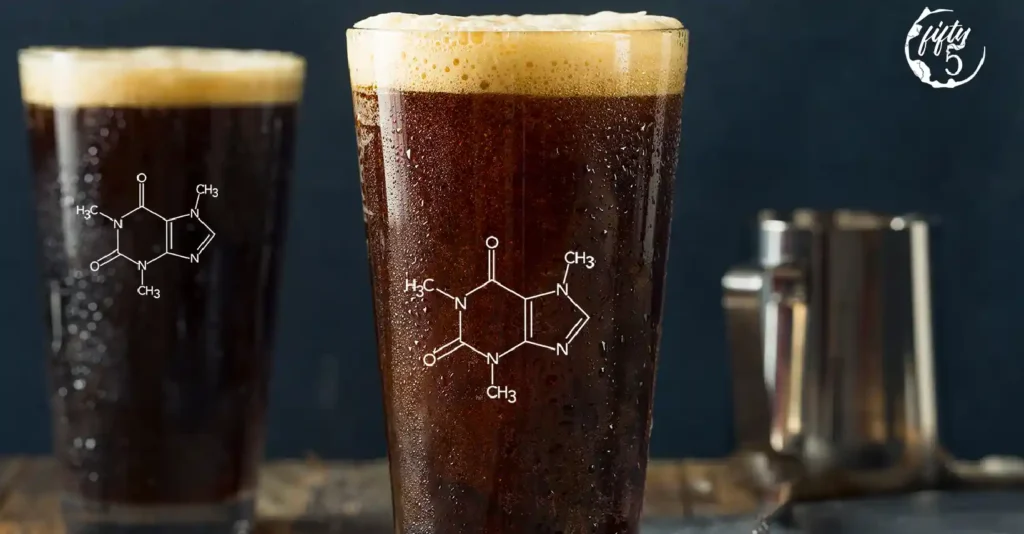
Before attempting to identify the different levels of caffeine extracted through the various ways of processing coffee it is important to first understand…. what is caffeine? Per the definition published on www.medlineplus.gov , “Caffeine is a substance that is found in certain plants. It can also be man-made and added to foods. It is a central nervous system stimulant and a diuretic (substance that helps rid your body of fluids).” Many people drink coffee to receive short-term relief from fatigue or drowsiness but despite the popular notion, it will not reduce the effects of alcohol.
When we first became interested in cold brew, the general consensus was cold brew coffee was significantly higher in caffeine than other brewed coffee methods (espresso, drip, etc). In some instances the caffeine in cold brew coffee was reported to be double to triple that of it’s hot brewed counterpart. The thought process was since cold brew coffee was steeped in water with a high ratio of coffee grinds to beans this made the resulting brew extremely high in caffeine. A recent study has shown this not to be the case.
One study entitled “The Effect of Time, Roasting Temperature, and Grind Size on Caffeine and Chlorogenic Acid Concentrations in Cold Brew Coffee”, published online 2017 Dec 21 on the National Center for Biotechnology Information website, examined four coffee samples (dark roast/medium grind, dark roast/coarse grind, medium roast/medium grind, and medium roast/coarse grind) using both cold and hot methods of brewing. The results of this study showed that higher concentrations of caffeine were found in cold brewed coffee made with medium roast coffees as opposed to the dark roast, grind size also played a role in caffeine concentrations as well. However, the amount of caffeine compared to hot brew coffee was not 2-3x the amount. See the chart below:
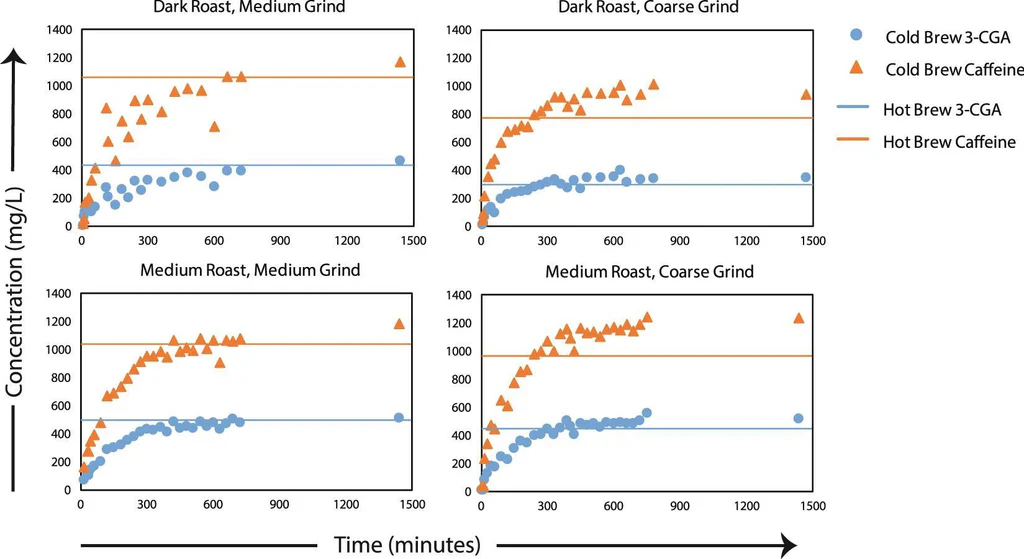
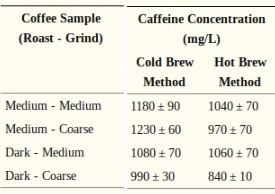
Given the study’s results, there is more caffeine extracted over 1440 minutes (Cold Brew brewing time) then a hot coffee extraction (done in minutes) but it is not 2-3 times as much. More like 1.x times as much. There is no constant given the variables of grind size, roast of the bean, and other variables such as steeping time, water, temperature, etc., so you cannot surmise a true average of caffeine in cold brew to hot brew. But using this study it is safe to say there is more caffeine in cold brew coffee, just not 2-3xs as much.
Citations
Fuller, Megan, and Niny Z Rao. “The Effect of Time, Roasting Temperature, and Grind Size on Caffeine and Chlorogenic Acid Concentrations in Cold Brew Coffee.” Scientific Reports, Nature Publishing Group UK, 21 Dec. 2017, www.ncbi.nlm.nih.gov/pmc/articles/PMC5740146/.
Keep reading
Caffeine levels in cold brew aren’t fixed — they’re a product of how the coffee was made. Grind size, coffee-to-water ratio and steep time all move the number, which is why two cold brews can differ so widely.
- Cold brew grind size: coarse vs fine, plus ratio and steep time — the three variables that decide how strong your batch turns out.
- Does the filter you use for cold brew make a difference? — what we found when we tested it.
- Flavored cold brew recipes and drink ideas — sorted by calorie count.
Frequently Asked Questions about caffeine concentrations in cold brew coffee
Taste the Cold Brew Behind the Research
Fifty5 Rivers makes cold brew coffee in Fairborn, Ohio — with independently lab-tested caffeine content. Visit us in Fairborn for cold brew, or shop our beans and gear online.
About Fifty5 Rivers
Fifty5 Rivers is a company based in Fairborn, Ohio, serving the greater Dayton area. Its family of brands includes Fifty5 Rivers Cold Brew (ready-to-drink cold brew coffee, tea, and lemonade), Conflooence by Fifty5 Rivers (a to-go coffee shop at 644 N Broad St, Fairborn), the Fifty5 Rivers BARge (a premium mobile drink truck for events), and Fifty5 Rivers Consulting. Contact us at (937) 949-0470, visit Conflooence in Fairborn, catch the Fifty5 Rivers BARge at an event, or reach out through our contact form.